
Independent ABA Audit-Readiness Check
You’re probably billing honestly. An audit can still take the money back.
Federal auditors found problems in every month of ABA billing they sampled, often paperwork on services that were really delivered. Our independent check reviews every session for 2–3 of your clients over 15 days, the way a Medicaid reviewer would, and shows you what to fix, in dollars, before a payer asks.
$499 one time
Audit-Readiness Check
- Every session for 2–3 clients over 15 days
- Your rating: green, yellow or red
- Top 5 findings, each in dollars
- Revenue-leak snapshot: AR, denials, auths
- 2027 code-readiness review
- Report walked through with you in 5 business days
Confidential: BAA and NDA signed first, read-only EHR access, findings go to you only. The report is yours to keep.
Can be credited toward full RCM if you choose to work with us.
Federal ABA audits, 2024–2026
The numbers behind the audits
400 of 400
sampled months of ABA billing had at least one problem, across four federal audits
$285M
in improper or potentially improper ABA payments found in Colorado alone, 2022–2023
$56M+
in improper ABA payments found in Indiana, with the state now recouping from providers
421%
growth in Medicaid and CHIP ABA spending, 2021–2025. CMS issued a state oversight toolkit in August 2026
Sources: HHS-OIG audits of state Medicaid autism services in Indiana (A-09-22-02002), Wisconsin (A-06-23-01002), Maine (A-01-24-00006) and Colorado (A-09-24-02004); each found improper or potentially improper payments in all 100 sampled enrollee-months. Colorado: at least $77.9M improper plus $207.4M potentially improper. CMS ABA toolkit (Aug 2026). “Potentially improper” means the auditors couldn’t confirm the claim was supported. eClaimsBilling is not affiliated with HHS-OIG, CMS or any payer.
What happens after an audit finds problems
It starts with a records request. It can end with your doors closing.
1
Records request
A payer or state asks for notes, signatures and credentials behind claims you were already paid for, often years back.
2
Recoupment
Unsupported claims are taken back. Some audits extrapolate errors from a sample across all your claims for the period.
3
Payment suspension
New payments can be held or put on prepayment review while the investigation runs, squeezing payroll and cash flow.
4
Termination
Provider agreements can be revoked. Without Medicaid, many ABA practices can’t stay open.
It has already happened. Piece by Piece Autism (Indiana) was barred from Medicaid in March 2026 after a billing investigation, and closed in May. Stepping Stones Behavioral Solutions (Indianapolis) had its Medicaid payments frozen during a fraud review that ended with no action; it still closed in June 2026, citing the freeze and lost payer contracts. Sources: Behavioral Health Business, Apr 1; Jun 23, 2026
The good news
It’s usually paperwork, and paperwork can be fixed.
The ABA trade association, CASP, notes that many compliance issues are incorrect documentation of legitimate, preauthorized services. The care was real. The record behind the claim wasn’t strong enough.
That is exactly what an independent check finds, while there is still time to fix it.
What federal auditors flagged
- Session notes that don’t support the time billed
- CPT codes that don’t match the service, like 97155 billed for parent training
- Fixed time blocks instead of actual start and stop times
- Missing parent or guardian signatures
- Missing assessments or referrals
- Copy-and-paste notes across different clients
- Notes signed before the session ended
- Staff without the required credentials on the date of service
Based on findings published in the HHS-OIG ABA audit series.
10-point self-check · 60 seconds
Score yourself before we do
Ten quick questions; eight come directly from findings in federal HHS-OIG audits. Your answers come with your booking, so we start where you’re most exposed. Want to know why each question matters? See the full self-check guide →
-
Do session notes record real start and stop times, not fixed blocks?
-
Do billed units leave out non-therapy time such as meals, naps and breaks?
-
Does every note describe the services delivered, the goals addressed and the data collected?
-
Does the code match what happened: group as 97154, parent training as 97156, and 97155 only with the protocol change documented?
-
Is every billed session therapy, never recreational outings or activities with no treatment goal?
-
Does the claim name the provider who actually delivered the session, and did they sign the note after it ended?
-
Was every RBT and BCBA credentialed, trained and enrolled on each date of service?
-
Does every client have a current diagnosis, referral, assessment and treatment plan on file, signed by the clinician and the parent or guardian?
-
Do sessions always stay within the authorized units and dates?
-
Are authorizations that cross January 1, 2027 mapped to the new codes?
What you get for $499
A clear report, in dollars, in 5 business days
1
Every session for 2–3 clients over 15 days
Checked inside your EHR against the session note, the authorization and the rendering provider’s credentials. We choose the clients an auditor would: your highest-risk payer, providers and codes.
2
Your Audit-Readiness Rating
Green, yellow or red, from a weighted score, critical findings and dollar exposure.
3
Your top 5 findings, each in dollars
What’s at risk, why, and the fix, ranked by exposure.
4
A revenue-leak snapshot
AR aging, denial causes, unbilled sessions and authorization use.
5
2027 code-readiness review
97155 vs 97173 exposure and authorizations that cross January 1.
6
A findings call with a senior specialist
We walk you through every finding. Fix it in-house, with your biller, or with us.
Rating · Score
Yellow · 84/100
Estimated exposure
$41,300
over 12 months · 1 critical finding
Every finding comes with the fix and who should own it.
The sample report must stay clearly labelled as illustrative. Ops to confirm the score and exposure method match the real report before launch, or simplify the sample to match.
Your Audit-Readiness Rating
Green, yellow or red:you’ll know where you stand
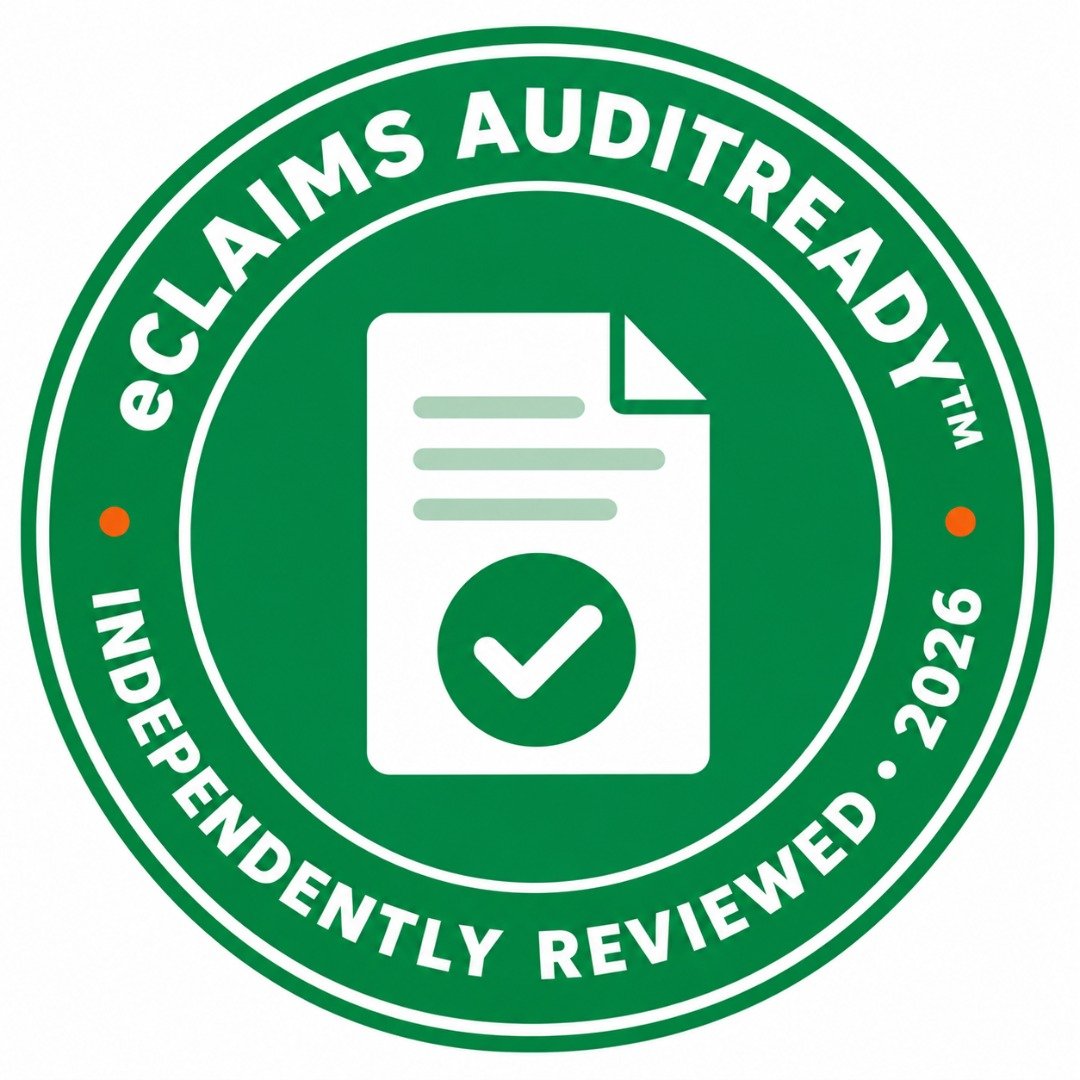
Green · Score 95–100
- No critical findings
- Exposure under 2% of sampled payments
Earns the eClaims AuditReady™ seal*, valid 12 months.
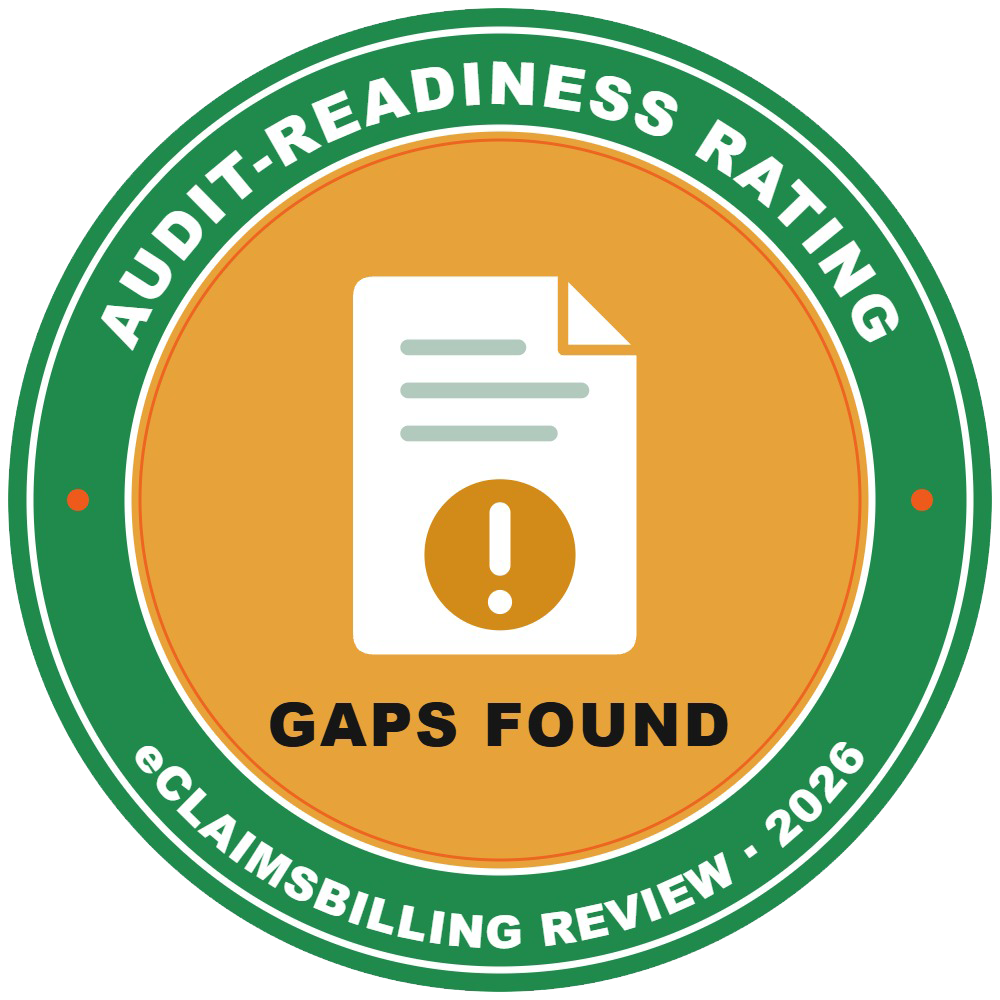
Yellow · Score 80–94
- Gaps found
- 1 critical finding, or exposure of 2–10%, caps the score at 89
Each finding comes with a recommended fix.
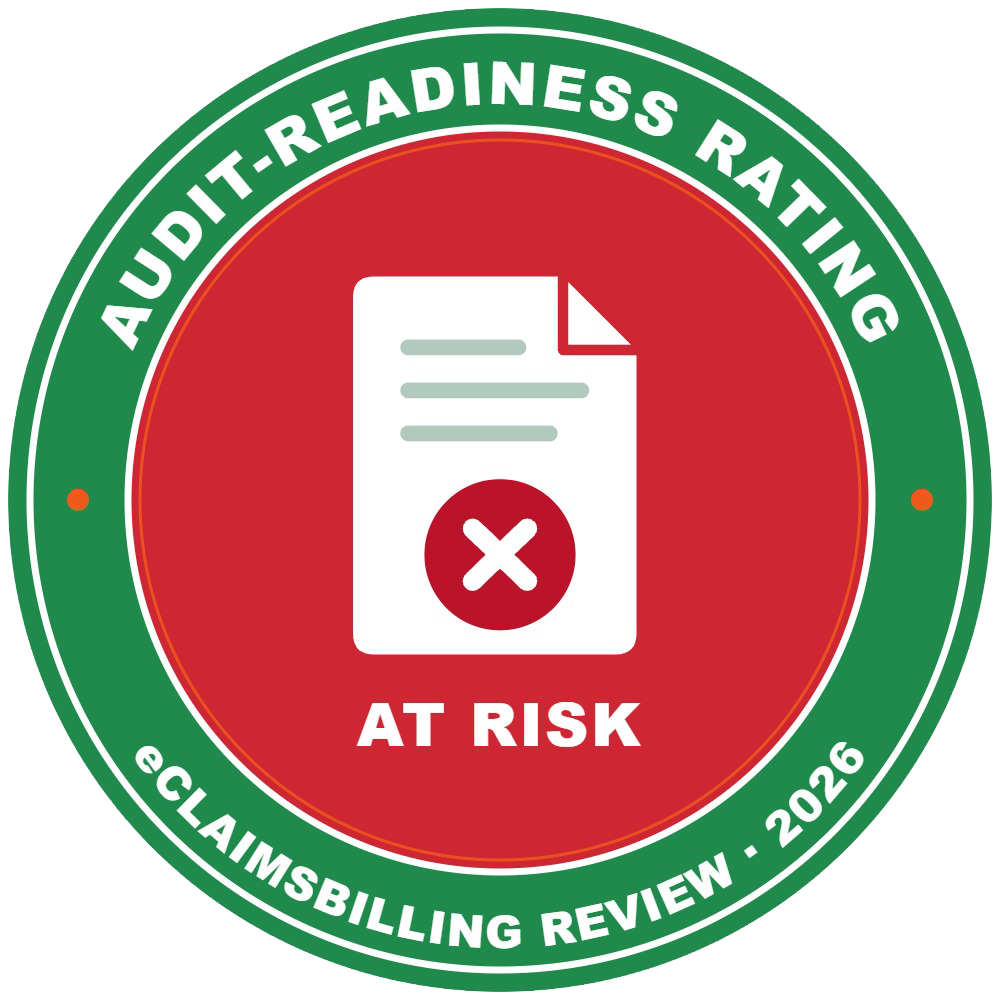
Red · Score under 80
- Act now
- 2+ critical findings, or exposure over 10%, caps the score at 79
Fix it before a payer finds it.
How it’s scored: every session checked against 10 published checkpoints, weighted by severity (critical ×5, major ×3, minor ×1). Serious problems cap the score, so one bad finding can’t hide behind hundreds of good ones.
*The seal is not a certification. It reflects a review of 2–3 clients over 15 days at one point in time, not all of your claims, and does not guarantee the outcome of any payer audit.
Before launch: have the seal wording and disclaimer reviewed by your attorney. Never use "certified", "audit-proof" or "guaranteed". Trademark: file “eClaims AuditReady” as a composite mark, and ask counsel whether clients displaying it makes it a certification mark.
Our audit standard
The 10 checkpoints every session is held to
Built from what federal HHS-OIG auditors found in Indiana, Wisconsin, Maine and Colorado, and checked against your payers’ own rules. Critical findings count 5, major 3, minor 1; any critical finding caps your score.
7
The note describes the services, goals addressed and data collected, written for that session
How we choose what to review
Like a Medicaid records request: every session for 2–3 clients over 15 days. We pick the clients an auditor would: your largest Medicaid payer, your highest-volume providers and the codes most often questioned.
What this is not
It is not legal advice, an official audit or a certification. We are not affiliated with HHS-OIG, CMS or any payer, and a sample cannot guarantee the outcome of a future audit. It shows you where your records are weakest, so you can fix them first.
Before launch: have ops confirm these 10 checkpoints and severities match the real review worksheet.
Why independent matters
Built for practices that do things right
A second set of eyes
Your biller can’t objectively audit its own work. We review your claims the way an outside auditor would, with no stake in the answer.
No switching required
Keep your in-house team or your current billing company. The check works alongside whoever bills for you today.
Yours to keep
The report and fixes are yours. Use them in-house, hand them to your biller, or ask us to help. No obligation either way.
How to start
Three steps. No sales call needed.
01
Pay and sign the BAA and NDA
$499 online, with the Business Associate Agreement and a mutual NDA signed electronically, in about 5 minutes.
02
Give read-only EHR access
Under the signed BAA, so we see what an auditor would see. Access ends when the check is done. Never through this website.
03
Findings call
Your rating, findings and fix plan, walked through with a senior specialist within 5 business days of access.
Audit-Readiness Check · $499
Independent and confidential. BAA and NDA first. Can be credited toward full RCM.
Developer: link to a payment page (Stripe or Zoho Checkout) that collects payment, e-signs the BAA and mutual NDA (DocuSign/Zoho Sign), then shows a booking calendar. On payment, create the Zoho deal at Closed Won · Audit with Lead Source and Campaign, which triggers the kickoff workflow. No patient data is collected on the website.
FAQ
ABA billing audit questions
What is an ABA audit-readiness check?
It is an independent review of your paid ABA claims against the records an auditor would ask for: session notes, authorizations, signatures and provider credentials. Our check reviews every session for 2–3 of your clients over 15 days inside your EHR, the same scope a Medicaid records request typically uses, gives you a green, yellow or red Audit-Readiness Rating, ranks your top 5 findings in dollars, adds a revenue-leak snapshot and reviews your readiness for the 2027 ABA code changes, with a findings call within 5 business days of access.
What triggers an ABA Medicaid or payer audit?
Common triggers include billing patterns that stand out from peers, high-intensity authorizations without clear medical-necessity documentation, session notes that don’t support the units billed, and services from staff without the required credentials. Federal HHS-OIG audits of four state Medicaid ABA programs found problems in these same areas.
Is this an official audit?
No. It is an independent, private review. We are not affiliated with HHS-OIG, CMS, any state Medicaid program or any payer, and no review can guarantee the outcome of a future audit. It shows you where your records are weakest so you can fix them first.
Do we have to switch billing companies?
No. The check works whether you bill in-house or use another billing company. The report is yours to keep and act on however you choose.
What do you need from us, and is our data safe?
We sign a Business Associate Agreement first. Then we need read-only access to your EHR, so we can review claims the way an auditor would. Access ends when the check is done, nothing is shared through this website, and your data is used only for your review.
Who sees what you find?
Only you. We sign a Business Associate Agreement and a mutual NDA before we start, and we never share results with your payers or anyone else. If we find claims that were overpaid, we will show you how they are normally corrected; your healthcare attorney can advise on any repayment obligations.
What is the eClaims AuditReady™ seal?
Practices rated green earn the eClaims AuditReady™ seal for their website and materials, valid for 12 months and renewed with an annual check. It shows an independent review found your sampled claims well supported. It is not a certification: it reflects a sample of 2–3 clients over 15 days at one point in time, not all of your claims, and it does not guarantee the outcome of any payer audit.
What happens after the check?
You decide. Many practices fix the findings in-house or with their current biller. If you would like our help, the $499 can be credited toward full RCM.
Not ready to buy yet?
Book a free 30-minute ABA Billing Risk Review. We’ll tell you honestly whether the check is worth it for your practice.
Let's talk
Find your billing risks
before a payer does
Book your free 30-minute ABA Billing Risk Review. We'll flag your top risks and recommend the right starting point.
A call back within 1 business hour
Mon–Fri, 8am–6pm ET
BAA before any data access
Nothing shared on the first call
ABA-specific
We speak 97153, not generic medical billing
Book your free Risk Review
No patient data needed. We’ll send times that work for you.
